Showing posts with label model railroading. Show all posts

Monday, November 21, 2022

OCR Progress Update

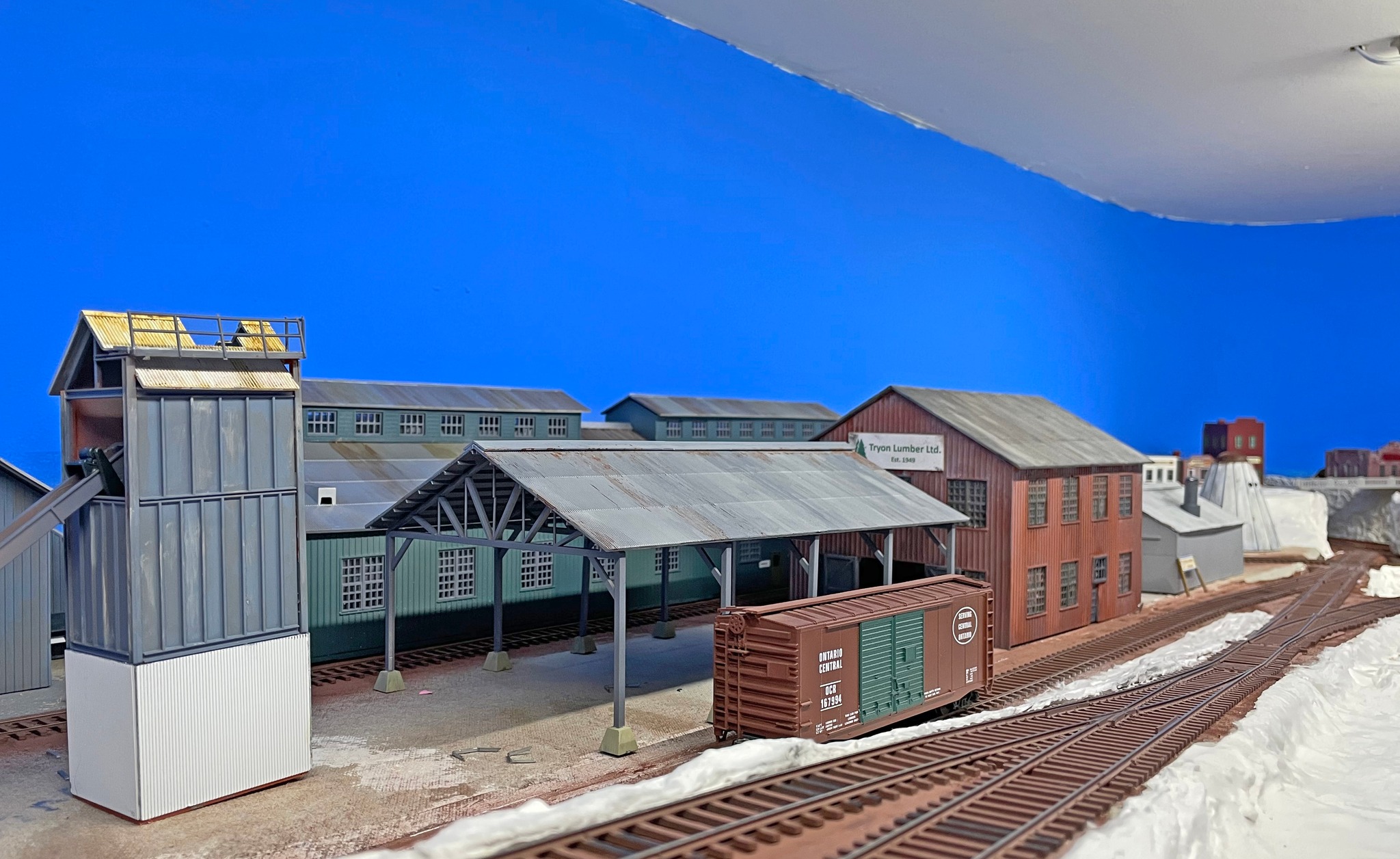
As some of you know, I'm lucky enough to be part of the scenery crew for my friend Bram Bailey's Ontario Central Railway. Bram and I share a common interest in Ontario railroading, especially the Ontario Northland Railway. Most of the crew heads to Bram's every Wednesday evening and some Saturdays to work on the layout. However, I live about an hour east, so rather than drive all those miles for each work session I focus on building structures at my work bench. Bram provides me a box of goodies, consisting of kits and other supplies, plus a template of the space available.  I have pretty much free choice on what I can do, such as kit bashing, paint colors, weathering, details and creating signage for business or structure.  So building usually starts with a few hours of research to see what sort of modifications I feel may be needed and to get an idea of paint schemes based on the prototype.  All of which gets documents in my OCR notebook. Then it's off to the work bench. As building progresses, I check each structure against the plan and clarify any questions with the Superintendent of the OCR. Once completed, I return the structure and the scenery crew then creates the final scene down the road.  I keep most of the leftover parts in case they are needed for future builds as you never know what may look good on another stock kit

Here are some recent examples of completed kits. 

Groner's Grain Elevator is named for a friend of Bram's who's vocation is that of a farmer. It is located at Elizabeth Bay.
Tryon Lumber is named for Bram's uncle Reg Tryon, who lived in Bracebridge, ON and worked most of his career in the lumber industry.

Zabrecky Fuel is a Husky Fuel and Propane distributor named after some of Bram's friends.

Tuesday, December 18, 2018

Adding Wood Chip Gondolas to the Roster


New Additions to the Layout

Woodchips are generated by lumber mills and separate purpose built woodchip mills in many areas of the U.S. and Canada. Most are used in paper or cardboard manufacture. While I have a paper mill on my layout, I chose not to model the wood chip portion due o space constraints.  Currently wood chips are received at the mill in the Yard and the loads removed after a set number of days before being returned to the yard as empty's.  Wood chips are received from either an off-site source, or from the Muskoka saw mill (on the layout).  As I discussed in another blog entry, I currently have four wood chip car resin kits manufactured by Alpine Railway Shops of Kettleby, Ontario, which were marketed as being representative of rolling stock used by CN and BCR for saw mills and paper mills. I have several additional car kits which are modeled after the BNSF cars to also handle chips.

A common variation of CP’s woodchip gondolas rebuilt from a 52′ gondola with extended sides.  Bill Grandin photo.

I recently found myself with three 52' gondola kits which I have tried to sell at several railroad shows, but unfortunately no takers. So rather then seeing them sit for months until the next show, I decided to try my hand at kitbashing these kits to resemble a photo I had seen of a CP rebuilt gondola that was placed into wood chip service. These would become lettered in the ONR, although to the best of my knowledge the ONR never had any cars that even approached this configuration.

From what I have been able to research, in the 1970's, CP Rail began to convert some randomly selected old boxcars to woodchip cars; this was done through the early 1980s.  These cars were made by cutting away the old roof and adding an extension. Later cars did not receive the extensions to the sides.  They also took an unknown number of 52' gondolas and extended the sides.

The story for my cars is that CP rebuilt these wood chip gondolas with extended sides from a standard gondola.  After some years of use in the north, CP parked them on a siding for lack of use.  The ONR then purchased them and repainted them to a woodchip only service marks that you see.
Proto 2000 Gondolas getting ready for conversion


Adding bracing for wall extensions. I didn't like the looks of this so the other two cars were done by adding bar stock

No matter how carefully you cut, there are always gaps. Next step some sanding followed by painting


Finished product in chevron scheme
Finished gon in the progressive paint scheme and added Wood Chip Service Only. Note I carried all of the ribs forward on this car after realizing that the gon looked odd with only alternating ribs. Still need to make a load for this unit

Monday, November 9, 2015

Model Railroad Open Houses

One of the more unique facets of this hobby is how people will open their homes to perfect strangers  so that they can show off their modeling talents as well as progress building a model railroad. This has become an annual occurrence in northeast Ohio, as well as other parts of the US, during the month of November. Within our local area, we are lucky enough to have two Divisions of the NMRA as well as several independent clubs, partake in layout visits. This past weekend, Division 4 had four layouts open in the areas south of Cleveland, and I was lucky enough to get to get all those fall chores, such as gutter cleaning and leaf raking, done so that I could visit each location.  It also didn't hurt that the day was a mixture of sun and clouds, as well as cooler autumn temperatures, making nice conditions for a drive in the countryside. 

The first stop was the Allegheny and Northern, a layout created by Dave Bitte. The HO scale Allegheny & Northern is a free-lanced, short line railroad located in central-eastern West Virginia during the summer of 1965. The unique aspect to this layout is viewing everything through a series of openings in the valance, which runs from the ceiling to below the operating level, making each scene appear like a museum diorama. The backdrops are also sensational. The RR supports branch lines, interchanges and multiple on-line industries to keep a crew of 7-8 busy.


Upper and lower valence


Diorama view of part of the layout, the upper and lower valence easily trick you into thinking that these are rolling hills within WVa

My next stop was to Jerry Kreuger’s basement, where he is in the process of modeling central Illinois in the late 60s to the early 80s. This double deck layout is currently under construction, although both levels have been built and connected by a massive, two track helix. The lower level is primarily staging and classification yard/engine facility. 


Third stop of the day was Aaron Dupont's USS-Acme Steel layout.  This is a switching layout loosely modeling the Chicago area. Main industry is USS-Acme Steel featuring three blast furnaces, basic oxygen furnace, rolling mills, sintering plant and all the necessary support buildings. Also non-steel related switching area representing the Calumet River area. Continuous running loop around 22' by 50' basement featuring 50 car trains.


Entire layout is devoted to switching this massive steel mill; requires 5 operators

Last stop for the day was the Union Valley Central RR, built by John Puch.  This is a double loop HO scale layout based on small towns in Ohio and Pennsylvania. It also features an operating coal mine, power plant with coal dumper, beer factory, interchange track and small yard.


Nice two-room layout with lots of running and great scenery

A great day of model railfanning and thanks to all for opening up their layouts.

Saturday, April 4, 2015

Kawartha Lakes Railway History

The Kawartha Lakes Railway is my HO scale freelance railway which incorporates certain elements of Ontario based industries and scenery into a fictional road.  The layout was designed to incorporate aspects of two of my favorite roads, the Ontario Northland Railway (ONR) as well as the Canadian Pacific Railway (CP Rail).  In essence, I have stretched the operating area of the ONR over into part of an area covered by the CP, as well as running track south to link with another area which the CP actually covers.  The railway is based on prototypical businesses found in the Peterborough/Lakefield region and well as several present in the Ottawa Valley. 

The setting is September 1985, as the summer comes to an end and the ever-changing weather of autumn descends upon the near north regions of Ontario. 

  
Throughout the KLR, I have tried to incorporate the history of the area into the areas that I model.  While certain key features or aspects couldn’t be modeled due to size constraints, I have tried to include enough key industries for realistic operations, without making the layout too busy. My goal was to mimic the remoteness of the area, having long runs between the yard and the various industries served.  Certain industries that are unique to the area have been included, as well as a few industries which are found in other portions of southern Ontario, but for the convenience of proto-freelance modeling, have been moved to fit onto the KLR. 

The primary purpose is to have the railway serve several small to medium sized industries located in the rural locales of Ontario.  The KLR's traffic base includes forestry products (such as paper, pulpboard, dimensional lumber and pulpwood) along with mining and several other industries.  The rail line serves a number of growing customers including Spruce Falls Pulp and Paper Company, Sherwin Williams Canada, Ontario Natural Products, Indusmin Canada, Ontario Hydro, Beaver Lumber .

The two largest industries on the layout include the Spruce Falls Pulp and Paper mill, which was modeled after the Tembec mills in Temiscaming, Quebec and Kapuskasing, Ontario.  The Unimin mine in Nephton, Ontario, which produces syenite (a mineral in the feldspar family used in glass making and ceramics), and the Muskoka Timber Ltd. operation serve as the other focal industries. The primary interchange is with the CP at Pembroke and Toronto (off the modeled layout), with a secondary interchange with the ONR at North Bay.  While CP discontinued trains east of Havelock and CN terminated its running line to Lakefield, the Kawartha Lakes Railway was able to purchase the trackage and become a profitable shortline, serving the small industries scattered throughout Ontario. 

The KLR was started in 2004, after the dismantling of a predecessor 9x12-ft oval layout. The layout is built using a series of modules, which generally follow the Freemo format.

Friday, April 3, 2015

Kawartha Lakes Railway Introduction

While attending the 2015 RPM-East meet in Greensburg, PA last week, I had the chance to hear Eric Hansmann discuss the idea and merits of web blogging.  Eric made me realize that creating and maintaining a blog wasn't as arduous as I first imagined, and that it was a great way to share ideas.  Therefore in effort to document my Kawartha Lakes Railway, as well as start a discussion of some of my favorite modeling topics (paper mills, saw mills, forest products industries), I decided to develop this blog to document the progress of my HO scale model railroad, railfanning trips and modeling the above industries.   

It's been just short of a year since I started in on the re-design and construction efforts on the KLR.  The original KLR was started just before 2005, and coincided with our local NMRA division hosting a regional convention. In 2011, we once again hosted the MCR convention, which prompted a large amount of work on the layout.  The 2014 NMRA National Convention followed this, where the KLR hosted both a bus tour and a visit from members of the Layout Design SIG.  During the convention, the Layout Design SIG posed the question "what would you have done differently with your layout".  After several operating sessions prior to the convention, this topic had been burning a hole in my brain, as I realized that switching at my paper mill wasn't as fluid as I would have liked, nor was switching several other industries.  The question prompted me to take action, initially with a re-design of several spurs to allow for better storage of cars and then with construction of several new modules, which allowed me to re-design my paper mill.  

I hope to post some pictures next time showing the progress after some of the new track has been laid and I can once again run trains and begin switching operations.