Showing posts with label Ontario Northland. Show all posts

Monday, March 22, 2021

Yard Building

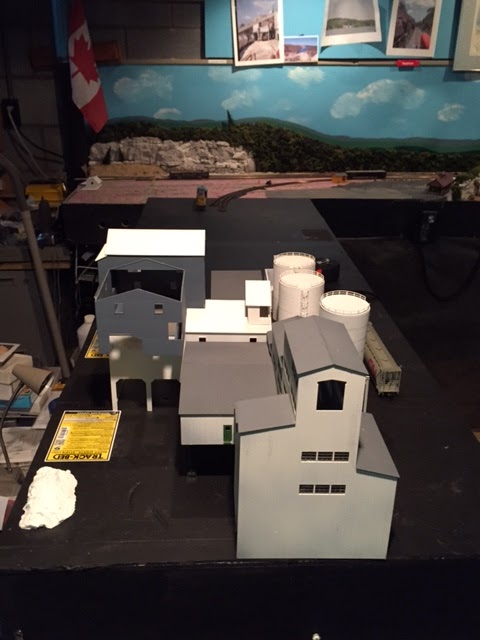
With the pandemic still in full lockdown mode, I finally got the time to build a small yard and retire a small temporary yard I had built years ago.  The new yard is 10 feet long and sits on two modules which are joined together.

As I was planning my new yard, which was to be situated at the end of the layout, I wanted to include some sort of yard office, as well as a freight shed that had been removed from a different part of the layout. Looking at some photos, I realized that I had enough room to make a fairly complete scene by using the Mechanical Building at Englehart as an example. The other side of the track would house my freight shed.

Drone view courtesy Mike Robin

South side of Bldg; scale house in right foreground

South side of Bldg

North and east walls of the Bldg

The build started with a general Pikestuff building kit, with a few extra side panels added and cut down in height to make a lower roofline. Unfortunately I only had photos of 3 sides of the building, and the pandemic cancelled two trips I had planned to get the info. So the west wall is a complete guess.

One detail that I noticed going back through several years of photos was that the roof and building sides have two different shades of blue, as well as downspout configurations. Perhaps due to a building expansion? Matching the weathering condition and color was a real challenge and although not a true match, the result is pleasing to my eye. Maybe I'll try to alter it at some later date.

One of the challenges was to match the various windows and their position on the wall without any true measurements.  Cutting the doors and windows would turn out to be fairly time consuming, as the Pikestuff panels are fairly thick plastic and required a steady hand and many knife blades to cut them all.

The challenge now is to complete the scene in the background by adding all of the details that you see in the upper photo.  I just finished building the small building directly behind the main structure, as well as removed the trucks from an old Athearn 40 foot ONR boxcar which has been parked in the weeds.

The gravel type pavement was created by pouring tile grout to the consistency of a slushy and then drawing it relatively flat and level across the area.   I plan to weather some of the gravel area with pan pastels to give it more of a well worn look.  Now I just have to find or build the suitable ONR service vehicle(s) to park outside of the building.


Wednesday, September 26, 2018

ONR Convention - 2018 @ Kirtland Lake - Saturday

Day 2 of the ONRHT&S convention had us reviewing the morning lineup and trying to determine which trains and locations we could photograph.  Our first train of the day was the southbound train from Englehart to North Bay.  ONR SD75I #2105 was leading a newly repainted SD40-2 #1734.  While some of the group decided to shoot this train at Englehart, Bram Bailey, Mike Robin and I opted to head south to Earlton, where we had previously seen some piles of hay bales.

Southbound train passing by Mini Farm Rd crossing at Earlton. Photo by Ken Stroebel
We chased this train southward, however, he got ahead of us and we watched him beat us to the Hwy 11 crossing at New Liskeard and broke off the chase.

Pacing shot through the farmers fields around Earlton. Photo by Ken Stroebel

We found the ditcher still working at New Liskeard after a brief lunch break at Gillies, however, the sun was mostly behind the clouds and the ditcher would soon be headed back north.

Work train at the New Liskeard station siding. Photo by Ken Stroebel

So it was back to Englehart as we tried to remain one step ahead of the northbound work train.

Work train approximately 1/2 mile east of the Englehart River bridge. Photo by Courtland Saunders


Northbound Work 1733 is captured crossing the Englehart River. Photo by Mike Robin.
ONR 1733 and 1735 at Englehart. Photo by Terry Shwetz.

Catching the work train was our last bit of railfanning for the day, as attendees had an appointment to tour the Museum of Northern History in Kirkland Lake. Located in the former chateau home of successful mine owner Sir Harry Oakes, this museum focuses on Northeastern Ontario including the Kirkland Lake area.  The site’s collection dates from 1907 to the present and includes many objects related to the home as well as mining industry and documents from the area.

Chateau of Sir Harry Oakes

Various mineral and rock specimens; note large scale on top of cabinet

Our evening presentations included a review of mining and smelting operations for Kidd Creek, Rouyn-Noranda, and Sudbury, as well as an overall review and discussion of the geology of the area and how the various ore deposits came to be.  Bill Woods then taught us how to make conifer trees using wire, hemp sisal, spray paint and ground foam.


Tuesday, September 25, 2018

ONR Convention - 2018 @ Kirtland Lake - Friday

This years convention was held in Kirkland Lake, with accommodations provided by the Super 8 motel.  Our thanks to Peter Ross for doing all of the planning and up front work to secure locations. Special thanks to Gerald Harper for helping to arrange our Friday morning trip to the Glencore Horne copper smelter located in Rouyn-Noranda, Quebec.  The following set of blog entries recounts my impressions as well as the fun we had once again getting together to share our interest in the Ontario Northland railway.  I will try to post some thoughts and photos to summarize the daily activities. 

We begin our day after a great meal on Thursday evening at Vienna's Bar & Grill. Somewhere in the night the weather changed to rain and cooler temperatures.  A quick breakfast and we were off to Rouyn-Noranda and the Glencore Horne copper smelter.  According to our two tour guides, Glencore is one of the world's largest copper and precious metal producers, as well as North America’s biggest recycler of electronic components. 


Aerial view of smelting operations (Photo courtesy Horne website)

Copper casting (Photo courtesy Horne website)
Our tour started with an overview of the company and operations which take place at this site, as well a history and discussion of the geology of the area and previous copper deposits.  After suiting up in coveralls, safety glasses, steel toed shoes, dust respirator, gloves and ear protection, we got the chance to see the molten copper coming out of the furnace as well as seeing the copper cast.


Hey we look like miners....Check out all of that PPE on ONRHT&S members as we get ready to enter the smelter bldg
Boxcar spotted outside of smelter. Note reporting marks
Sulfuric acid plant


Switching gondolas

Our trip back included a stop at Cheminis, MP 32 of the where members of the ONRH&TS got a chance to photograph train 211 as it passed through on its way to Noranda.  
Cheminis MP 32. Photo by Mike Robin

Passing MP32 sign. Photo by Ken Stroebel

After returning to the Super 8, Bram Bailey gave an outstanding presentation of his new book, Trackside around Ontario’s Cottage Country, which will be available on January 5, 2019.  This book will showcase various ONR, CP, ACR and CN trains around the cottage country of northern/southern Ontario. Looks like another solid read from Bram and shouldn't be missed.


Saturday, August 5, 2017

Modelling a Paper Mill – Part 1 Origin of the Spruce Creek Pulp & Paper Mill

One of the key features on the layout is the Spruce Creek Pulp and Paper Mill, located on two 2’ by 6’ modules in the center of the room.  The mill was modeled after several mills located in northern Ontario, including the mills at Kapuskasing, Smooth Rock Falls, Iroquois Falls and the Tembec mill at Temiscaming, Quebec.  While each of these mills offers unique aspects to model, they also have several common themes, including rail access, locations along a major water source, multiple ages of buildings and general building architecture.  Several of them have operated with their own switcher engine, which shuttled empty and full loads between the mill and nearby storage tracks.  It was this particular aspect that was of primary importance and I wanted to include in my paper mill complex.  Therefore, observers will quickly find that switching power for the Spruce Creek plant consists of both an Alco S13, patterned after the Spruce Falls 108 and the newer GMD GP7 Mattagami 168 (ex ACR 168).  Both units may still be found in Kapuskasing, although as of 2017, neither unit is active and sits on the mill property in pieces or in the weeds.

What’s in a Name 
One of the first and toughest decisions was what to name the paper mill, since it would be a major feature of the railway.  I had no intent of modelling a town to go along with it, but I wanted to recognize local features of the area, yet at the same time create a fictional area that was in keeping with other local town names.  I ultimately chose Spruce Creek Pulp & Paper as my fictional paper mill and town.  Spruce was chosen based on the varieties of spruce found as predominant trees in northern Ontario.  While I wanted to add a waterway feature to the name, "Falls" was already done and it basically came down to whether the second part of the name would be river or creek. For no real reason, creek won.

Like many layouts and modelers, I borrowed certain aspects of each of the mills to form my own.  I wanted a fairly heavy and diverse amount of traffic, so the choice to model both a paper and pulp mill became obvious.  I was also lucky enough to have toured several of the mills, so I was able to incorporate some of the aspects I had seen on these tours into my layout.  And lastly, I had to compress as much of the mills that I had seen into a small, finite space on the layout. I knew that certain buildings would have to be scratch built, while others could come from kitbashing or using straight builds from existing kit structures.  I also wanted to use photo backdrops of the mills into my scenery.  Certain large areas such as chip unloading would not be possible, due to size restrictions, while at the same time maximizing the amount of trackage was key.

So let's take a quick look at some history for the area.
 
History of Local Mills
Kapuskasing (Spruce Falls Company) - the timber limits around Kapuskasing were sold to Kimberly-Clark in 1920. The new Spruce Falls Company Ltd. began the development of the first pulp mill in Kapuskasing under the direction of F.J. Sensenbrenner, a Vice President of Kimberly Clark Corporation for the next 20 years. The small sulphite mill started up in late 1922 with four 12-ton digesters and a daily output of 75 tons of pulp. Spent liquor was discharged untreated into the Kapuskasing River.  In 1923, a water storage and hydro electric dam was built by Morrow and Beatty Ltd. of Peterborough at Spruce Falls. In 1925, the Spruce Falls Company Limited was awarded additional timber limits to the north and south, bringing their total limits up to 11,830 square kilometers (4,570 sq mi).  In 1926, the Spruce Falls Power and Paper Company was incorporated under joint ownership of Kimberly-Clark and The New York Times. The new company negotiated two additional hydro power leases to the north on the Mattagami River at Smoky Falls and Devils Rapids. Work to build a 550 ton/day paper mill at Kapuskasing, a 75,000 HP hydro generating station at Smoky Falls and a 80 kilometers (50 mi) railway and power line connecting the two got underway in the spring of 1926. The contractor for the entire project was Morrow and Beatty Ltd. of Peterborough.  Since July 13, 1928, The New York Times has been printed entirely on Spruce Falls paper. The mill has run continuously ever since.
Tembec's mill at Kapuskasing (2017)
Smooth Rock Falls (Tembec) - the town of Smooth Rock Falls lies on the Mattagami River and on Highway 11, between Cochrane and Kapuskasing.  The Smooth Rock Falls economy was dominated by the Tembec Malette pulp mill, which unfortunately was closed on December 5, 2006.  The pulp mill was subsequently dismantled and demolished, leaving nothing but an empty field and some vague hopes for redevelopment.   
Smooth Rock Falls - photo courtesy Mike Robin and onrgallery.com
Iroquois Falls (Abitibi) – Iroquois Falls lies on the banks of the Abitibi River, west of Lake Abitibi and approximately 40 miles northeast of Timmins.  Iroquois Falls' primary industry was a large mill producing newsprint and commercial printing papers.  The paper mill, then called Abitibi-Price, merged with Stone-Consolidated, and then with Donohue Forest Products, and finally with Bowater to create Abitbi-Bowater. On 17 April 2009, Abitibi-Bowater sought bankruptcy protection, emerging from it as Resolute Forest Products. Five years later, Resolute announced its permanent closure.  As of 2017, the buildings housing the paper machine and other structures are in the stages of demolition, although the engine house still stands.


Iroquois Falls - photo courtesy Mike Robin and onrgallery.com

Temiscaming (Tembec) – the southernmost of the mills actually resides in Quebec, located at the south end of Lac Témiscamingue on the upper Ottawa River.  The area experienced major growth when the Riordon Pulp and Paper Company built the Kipawa Mills pulp and paper mill there in 1918.  The Canadian International Paper Company, bought out the Riordon Company in 1925.  In 1972, when the company decided to close the mill, the employees formed Tembec to take over the operation of the mill. The mill produces chemical products, specialty cellulose, boardmill and high yield pulp. Unfortunately, the Temiscaming mill is located across the river and rail operations are difficult to photograph with all of the trees along the rivers edge.


Temiscaming mill

Monday, July 17, 2017

2017 ONRH&TS Convention Preview

Follow along as the guys from Ohio (plus one Niagara Falls attendee) make the trek to northern Ontario and this years version of the ONRH&TS convention.  This blog will try to keep a running tab on railfanning and convention activities as we go through the week.

The Bailey Prius mobile departs Vermilion at 0001 dark Wednesday and travels eastward to pick me up around 0130 before we head towards the Peace Bridge and hopefully reach Toronto early enough to avoid the daily traffic snarls.  Along the way we will add Bill Woods in Niagara Falls to our Prius seating and depending on what is moving, probably will spend the night in Englehart.  A side trip to Bracebridge along the way may be in order if the weather cooperates, as Bram would like to get some building shots for a potential expansion project to the layout.  But I'l let Bram fill you in on those plans at the convention.  On Thursday we plan to chase our way to Hearst, making our arrival in time for the group dinner.

Current plans are:

Friday - tour the Cochrane shops
Satursday - tour the paper mill at Kap
Sunday/Monday - travel day home (although the OH car will be railfanning along the way so it takes us two days to get back)

So stay tuned to this blog for updates and some photos.  Photo bag is packed and batteries charged.  Extra radio is also in the bag and ready to catch some ONR action.  The weather forecast looks good and I'm really looking forward to touring the paper mill and maybe getting some new ideas so that I can finish my own paper mill modeling project.

Sunday, July 3, 2016

Summer Ops Session

Like many model railroaders, I tend to work on small, isolated projects during the summer if I can find some free time.  I usually try to finishup any large projects for the KLR in early May, as I know that my time becomes spent more and more with yard work, maybe some railfanning and other summertime recreational activities.  By about the 1st of June, engines have been put away and I start making a list of upcoming projects that I'll start as soon as the cooler months roll around.

However, one of my local friends now finds himself splitting his time between northeast Ohio in the late spring to early fall, and Arizona the remaining months.  Before his move, op sessions on the Ontario Central were held at various times throughout the year.  Now the op sessions are once per month, starting in June.  While it may not be the traditional time for operating a model railroad layout, it does make for a nice diversion from yard work. The last op session I attended was very small in attendance, with only one other regular operator present.  However, it turned out to be a great session, as we were both able to run our trains and we simply did away with a time clock.

Pulling loaded boxcars from the warehouse

Arrival of the paper mill turn...it's going to be a busy day for the crew


I chose the paper mill turn, which is a train I have run before.  I really enjoy this train, as it gives me ideas on how I might switch out my own paper mill. It usually takes about 2.5-3 hours to get to the paper mill and do all of the switching. It's one of those jobs that keeps you very busy, and you don't actually realize the amount of time which has elapsed, as your having that much fine doing it.  And isn't that what model railroading should be all about? So thanks Bram for holding the summer op sessions, and I look forward to the next one.

Thursday, November 26, 2015

System Map


When I began to develop the idea of modeling in southern to central Ontario, one of the key questions was what would a system map look like and how much area would I be able to realistically be able to cover in the space allotted me and keeping within my modular system.  My largest worry was that I would have no problems filling the layout with too many industries and not enough scenery, and that the layout would appear to have a very cramped feeling.

While my first ideas for a system map were actually drawn out on a Ontario Provincial road map, as Google has offered more services, I opted to convert my system map to an electronic version.  The system map has information embedded into each location, which supplements my KLR history, and allows a quick glance at prominent industries along the line.  I have also added the general ONR, CN and CP tracks as reference, and ultimately, more information about these lines will also be added.

Kawartha Lakes Railway System Map

Friday, July 24, 2015

ONRH&TS Convention Time

Here are additional photos of the layout, albeit a little later than my intended timeline

 Commonwealth Plywood
 View of the KLR upon entering the basement

 Pembroke aisle, featuring Commonwealth Plywood and Beaver Lumber

 Muskoka Timber module

 Main street of Pembroke under construction. A new station is coming in the upper left corner of the photo.

 Niagara Distribution module

 Rough in of the Unimin mine module. Future plans may see this module relocated to another spot.

 Nephton countryside

 Corner module

 ONR 1737 crossing Eels Creek module

 Farm #2 module

 Paper Mill (warehouse and engine shop under construction)

 Paper Mill module 1
Paper Mill module 2
View of the NW corner modules.  Farm in the foreground, Comenico Fertilizer and station on the left central part of photo.

 Quaker Oats & Canada Malting Company Ltd. corner
 Quaker Oats & Canada Malting Company Ltd.
Sherwin Williams Paint plant under construction

Wednesday, July 15, 2015

ONRH&TS Convention Preview - Part 2

Pembroke is the home of several forest products businesses, including Commonwealth Plywood, MacMillan Bathurst Inc (corrugated containers), and Temple Inland(Medium Density Fibreboard). While not all of these industries are modeled due to space limitations, the KLR does service the Commonwealth Plywood facility. 

Here we see a few scenes from the downtown area as well as the siding for Commonwealth Plywood.

 True North Climbing Center & Sam's Bike Shop - named for my sons

Commonwealth Plywood

Royal Bank and RedTail Paddle Co.